
Hovering over an image will enlarge it and point out features (works better on desktop than on mobile).
 A camera indicates there are pictures.
 A speaker indicates that a botanical name is pronounced.
 A plus sign after a Latin name indicates that the species is further divided into varieties or subspecies.
Most habitat and range descriptions were obtained from Weakley's Flora.
Your search found 2 taxa in the family Blechnaceae, Deer Fern family, as understood by Vascular Flora of the Carolinas.
)
)
)
)
)

 Common Name:
Virginia Chain-fern
Common Name:
Virginia Chain-fern
Weakley's Flora: (4/24/22) Anchistea virginica FAMILY: Blechnaceae
SYNONYMOUS WITH PLANTS National Database: Woodwardia virginica FAMILY: Blechnaceae
SYNONYMOUS WITH Vascular Flora of the Carolinas (Radford, Ahles, & Bell, 1968): Woodwardia virginica 012-01-001 FAMILY: Blechnaceae
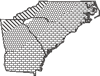
Habitat: Moist to wet, acid, organic soils, such as bogs, blackwater bottomlands, pocosins, and bayhead margins, sometimes in standing water, as in periodically flooded coastal plain depression ponds, wet hammocks
Common in Coastal Plain (rare elsewhere in GA-NC-SC)
Native to the Carolinas & Georgia
)
)

)
)
Common Name:
Netted Chain-fern, Net-veined Chainfern
Weakley's Flora: (4/24/22) Lorinseria areolata FAMILY: Blechnaceae
SYNONYMOUS WITH PLANTS National Database: Woodwardia areolata FAMILY: Blechnaceae
SYNONYMOUS WITH Vascular Flora of the Carolinas (Radford, Ahles, & Bell, 1968): Woodwardia areolata 012-01-002 FAMILY: Blechnaceae
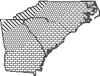
Habitat: Moist to wet, acid, organic soils, such as bogs, blackwater bottomlands, pocosins, wet hammocks
Common (uncommon in NC Mountains)
Native to the Carolinas & Georgia
Your search found 2 taxa. You are on page PAGE 1 out of 1 pages.